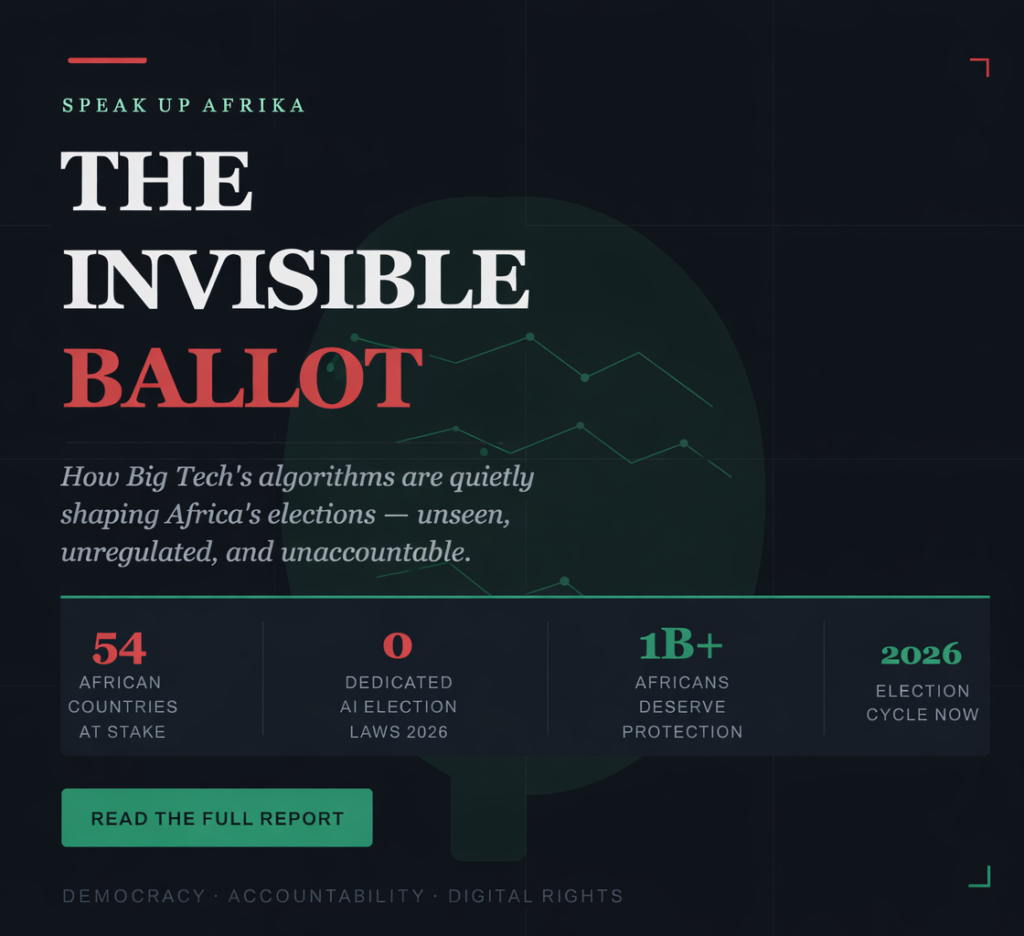
Every election season, millions of Africans reach for their phones to make sense of the political world. They scroll through feeds, share videos, debate in comment sections, and form opinions about candidates and crises. What most of them don’t realize is that somewhere between a candidate’s speech and a voter’s screen, an algorithm has already made a choice about what they will see — and what they will not.
This is not a conspiracy theory. It is infrastructure.
The digital platforms that now function as Africa’s public square — Meta, Google, TikTok, X — were not built to serve democracy. They were built to hold attention. And attention, as any political operative will tell you, is power. As the continent heads into the 2026 election cycle, with major contests expected across West, East, and Southern Africa, that power is being exercised with less accountability than at almost any moment in the continent’s democratic history.
The Algorithm Is Not Neutral
Political campaigns have always tried to reach voters where they are. What has changed is the surgical precision with which they can now do so. Data brokers and campaign analytics firms can segment voters not just by age or location, but by psychological profile — their fears, their loyalties, the grievances they have expressed in private searches and late-night scrolling sessions.
In several recent African elections, researchers and civil society monitors have documented how targeted political advertising flooded swing communities with content designed less to persuade than to inflame. Misleading narratives seeded in one language community spread before they could be checked. Emotional triggers — ethnic anxieties, economic fears, historical grievances — were packaged as political content and delivered by the million.
Democracy was not designed to withstand this. It was designed for citizens, not data points.
The Languages Left Behind
If the manipulation problem is about what people are shown, the moderation problem is about what is allowed to linger.
Big Tech companies have invested significantly in content moderation — but primarily in English, French, German, and Spanish. In Africa, where the political conversation happens in Kiswahili, Amharic, Hausa, Igbo, Zulu, and dozens of other languages, the moderation infrastructure is skeletal. Automated systems trained on Western language data routinely miss incitement, coordinated disinformation, and hate speech that any native speaker would recognize immediately.
The result is not a technical limitation. It is a prioritization decision. When harmful content circulates for hours — sometimes days — before intervention in African-language spaces, it does so because it was never given the same weight as equivalent content in markets that platform companies consider commercially or politically significant.
This is not an oversight. It is a structural choice, and it deserves to be named as one.
Your Data Is Someone Else’s Political Weapon
In the back rooms of every sophisticated African campaign, voter data is the commodity of the moment. Browsing history, social connections, religious affiliations, and purchase patterns — harvested, aggregated, and sold — power the microtargeting engines that decide which voters are persuadable, which can be suppressed, and which should be inflamed.
Many African countries, including Kenya, Nigeria, and South Africa, have enacted data protection legislation. But legislation and enforcement are different things. Regulatory agencies tasked with holding multinational technology corporations accountable are routinely outgunned — underfunded, understaffed, and lacking the cross-border authority to pursue violations that happen in servers halfway around the world.
The election-related data of African citizens is, for the most part, stored abroad. This is not merely a privacy issue. It is a sovereignty issue. When a Ghanaian election dispute requires data that sits in a data center in Virginia, the investigation has already been compromised.
The AI Election Has Already Begun
The 2026 cycle introduces a new and poorly understood threat: generative artificial intelligence deployed at scale in political campaigns.
AI-generated videos can now place words in a candidate’s mouth that they never said. Cloned voices can issue instructions to voters — stay home, the election has been postponed, your polling station has moved — indistinguishable from the real thing. Fake news websites, designed to mimic legitimate outlets with their logos and typography, proliferate faster than fact-checkers can flag them.
The technology is not hypothetical. It is already circulating. And the regulatory frameworks that would govern it — mandatory labeling of synthetic political content, independent algorithmic audits, liability for platform amplification of demonstrably false information — are either embryonic or entirely absent across most of the continent.
Accountability, when it comes, tends to arrive after the election. By then, the damage is irreversible.
A Structural Imbalance That Must Be Called Out
There is a phrase in technology policy circles: “tiered protection.” It describes the unofficial hierarchy by which global platforms prioritize their intervention capacity. Europe and North America sit at the top — multilingual human review teams, embedded fact-checking partnerships, rapid response protocols, and enforcement regimes with teeth.
Africa sits at the bottom. Not because African elections matter less to democracy, but because African markets are worth less to platform revenue models, and because African regulators have historically lacked the leverage to compel compliance.
This is the central injustice of the current moment. The same companies that mobilized extraordinary resources to protect the integrity of elections in Germany, France, and the United States have treated African elections as lower-priority environments. The voters are different. The profits from their data are not.
The Case for Collective Power
No single African government can regulate a trillion-dollar technology corporation. This is simply true, and any strategy premised on ignoring it will fail.
What African governments can do is act together.
The African Union, ECOWAS, the EAC, and SADC represent, collectively, a market of over a billion people. Harmonized digital governance standards — shared rules on political advertising transparency, AI-generated content labeling, data localization for election-related information, and minimum content moderation standards in African languages — would give the continent the negotiating weight that individual states lack.
Platforms respond to regulation when the cost of non-compliance exceeds the cost of compliance. The levers exist. The question is whether African policymakers will use them before the next election season, or after it.
What Accountability Actually Looks Like
Policy advocates are advancing several concrete proposals that deserve serious attention. Financial penalties calibrated to global platform revenue — not fixed amounts that large companies can absorb as a cost of doing business, but percentage-based penalties that actually sting — are being proposed in several jurisdictions. Mandatory pre-election algorithmic transparency reports, published in time for civil society to analyze them, are gaining traction. Requirements that fact-checking partnerships operate in local languages, not just English, are on the table.
None of these proposals are radical. They are the basic infrastructure of accountable digital democracy. The question is whether institutions will act fast enough to put them in place before this election cycle is over.
The Stakes
When people vote, they are exercising the foundational act of democratic life. That act depends on a reasonably honest information environment — not a perfect one, not a controlled one, but one in which the manipulation of public perception is constrained by some combination of law, norms, and accountability.
That environment is eroding. Not because of any single bad actor, but because the infrastructure of public discourse has been quietly handed over to systems optimized for engagement, not truth; for profit, not participation; for virality, not democracy.
Africa’s democracies are not fragile. They have survived coups and conflicts and constitutional crises of every kind. But the digital challenge is different, because it is invisible, because it is fast, and because it operates through the very tools that citizens use to participate in political life.
The algorithms will not fix themselves. That work belongs to the institutions, the regulators, the civil society organizations, and the citizens who understand what is at stake.
Speak Up Afrika advocates for democratic accountability, civic participation, and policy transparency across the continent.