
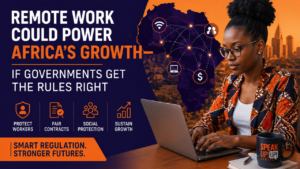
Remote Work Could Power Africa’s Growth—If Governments Get the Rules Right
Africa is exporting a new resource: digital labour. From software engineering to content moderation, millions of workers now earn in dollars, euros and pounds while living in Nairobi, Accra or Cairo. These cross-border income flows are becoming a meaningful, if undercounted, component of economic activity.
For policymakers, the opportunity is significant. Remote work delivers foreign income without the long timelines and capital intensity of traditional investment. It strengthens household consumption, supports foreign exchange inflows and offers a partial answer to youth unemployment. It may also slow emigration by allowing skilled workers to remain in local economies while accessing global wages.
But the current trajectory is fragile.
Much of Africa’s remote workforce operates outside effective labor protection. Workers are routinely classified as independent contractors, even when they depend on a single client and work structured hours. Contracts are often opaque, enforcement weak and dispute resolution skewed towards employers abroad. In lower-tier digital work—data annotation, transcription, platform microtasks—low pay and high insecurity are common.
Left unaddressed, this risks hardwiring a low-value equilibrium: a large, flexible but precarious workforce competing primarily on cost.
A more sustainable path would treat remote work as a strategic export sector—one that requires regulatory infrastructure as much as digital connectivity.
First, labour frameworks need updating. Recognising “dependent contractors” would extend basic protections—minimum standards on pay, working hours and termination—without undermining flexibility. Clearer classification would also reduce regulatory arbitrage and improve compliance.
Second, governments should standardise key elements of cross-border contracting. Model clauses on payment terms, intellectual property, data protection and dispute resolution would reduce friction for firms while strengthening enforceability for workers.
Third, social protection systems must become portable. Remote workers move frequently between roles, clients and platforms; benefits tied to a single employer are increasingly obsolete. Identity-linked systems for health insurance and pensions would allow contributions to follow the worker, improving long-term security without constraining labour mobility.
Employer of Record (EOR) models offer a complementary route to formalisation, enabling international companies to hire locally while complying with tax and labour regulations. With appropriate oversight, such models can expand formal employment without imposing prohibitive costs.
There is also a competitiveness argument for reform. Countries that provide regulatory clarity and worker protections are more likely to attract higher-quality demand—firms seeking reliable talent, stable contracts and lower reputational risk. In contrast, weak protections may draw footloose employers but discourage long-term investment.
Africa’s comparative advantage should not be framed as cheap labor. Its strength lies in a growing pool of skilled, digitally workers. Preserving that advantage requires avoiding a race to the bottom.
Remote work can become a durable engine of growth—supporting incomes, expanding the tax base and anchoring talent locally. But that outcome is not automatic. It depends on whether governments move quickly to build a labour market that is both flexible and fair.
In the digital economy, protection and productivity are complements, not trade-offs.