
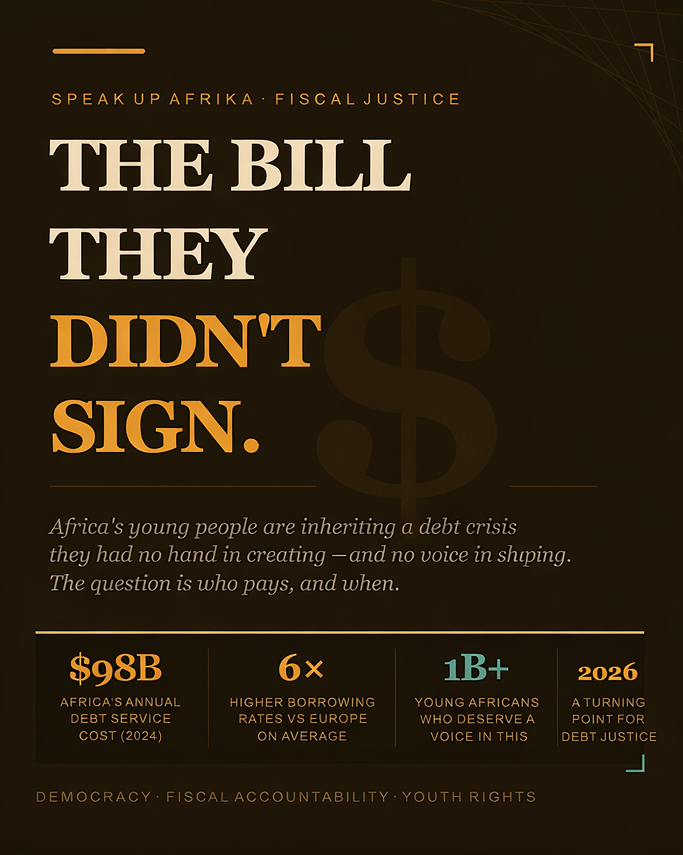
There is a particular kind of unfairness that is hard to see until you start doing the arithmetic. It doesn’t announce itself dramatically. It accumulates quietly — in the cost of a hospital visit, in the absence of a government job that should exist, in the university graduate who cannot find work and cannot understand why.
Across Africa in 2026, that unfairness has a name: public debt.
The numbers are staggering in aggregate, but they become truly legible only at the individual level. In country after country — Kenya, Ghana, Zambia, Ethiopia, Nigeria — governments are spending more money repaying creditors than they are investing in education, healthcare, or the digital infrastructure that a young, connected generation depends on. The compound effect of that imbalance falls, with startling precision, on the people least responsible for it: young Africans who are now entering adulthood and the workforce in an environment shaped entirely by decisions made before they had any political voice.
This is not, at its core, a fiscal story. It is a story about power, accountability, and who bears the cost of choices they were never asked to make.
To understand how debt becomes a generational problem, it helps to trace exactly what gets displaced when debt servicing becomes a government’s dominant budget obligation.
Every shilling sent abroad in interest payments is a shilling that does not go to a teacher’s salary, a rural health clinic, a broadband rollout in a secondary city, or a startup fund for a young entrepreneur who has the idea but not the capital. This is not metaphor — it is direct fiscal substitution, and its effects are measurable. In several African economies, the ratio of debt service to social spending has flipped in a decade: countries that once spent two or three times as much on education as on debt repayment now find that ratio reversed or nearly so.
By 2026, the more important question is no longer whether Kenya has a data protection framework, but whether ordinary people—especially young people—experience that protection in practice. As digital services expand rapidly, the gap between policy and lived reality has become more visible.
The hidden injustice inside this arithmetic is that African governments borrow at dramatically higher interest rates than their counterparts in Europe or North America — often four, five, or six times higher — for reasons that have as much to do with the structural biases of global financial markets as with actual country risk. A so-called “risk premium” that adds billions to a nation’s long-term debt burden is not a neutral market mechanism. It is a system that extracts wealth from already strained economies and delivers it to distant creditors, with the bill left on the table for the next generation to settle.
When debt distress forces governments into austerity — as it has in Ghana, Zambia, and increasingly in other African nations — the cuts rarely fall on the powerful. They fall on the programs that exist to build opportunity for those who don’t yet have it.
Internship schemes. Graduate training programmes. Entry-level public sector recruitment. Startup financing windows. Youth-focused health initiatives. These are the line items that disappear first when a finance ministry needs to find savings to reassure creditors. They are also, not coincidentally, precisely the programmes that determine whether a young person’s first years in the labor market set them on a trajectory toward stability or toward chronic underemployment.
The political economy of austerity is not accidental. Those who have already accumulated assets and secured positions are relatively insulated from cuts to programs that primarily serve new entrants. Those who haven’t are not. Austerity is, among other things, a transfer of risk from those who can absorb it to those who cannot.
The debt crisis and the transparency crisis are not separate phenomena. They are the same phenomenon.
In too many African countries, sovereign borrowing decisions have been made with minimal public disclosure — negotiated in closed rooms by technocrats and ministers, with terms that are not released to parliaments, let alone to the citizens who will spend decades servicing them. Infrastructure loans from bilateral creditors, commercial Eurobonds, and emergency credit facilities have all been arranged through processes that would not survive even basic scrutiny in the countries where the creditors are headquartered.
When the terms of a loan are opaque, accountability is impossible. Citizens cannot challenge what they cannot see. Parliaments cannot scrutinize what has not been disclosed. And the young people who will be paying for these decisions in the 2030s and 2040s have no mechanism to understand what was agreed on their behalf in 2015 or 2019 or 2022.
This is the core demand that has animated youth-led fiscal accountability movements from Nairobi to Accra to Lusaka: not the abolition of borrowing, but the radical transparency of it. Independent debt audits. Mandatory generational impact assessments that project what a given loan will cost during the peak working years of today’s twenty-year-olds. Real-time public finance dashboards that let any citizen see, in plain language, what was borrowed, what was spent, and what is owed.
These are not radical proposals. They are the minimum conditions of democratic governance in an era of complex sovereign finance.
In Makueni County in southeastern Kenya, something quietly extraordinary happened over the past decade: citizens were actually given a say in how public money was spent.
Through participatory budgeting processes that invited communities — including young people — to help set spending priorities, Makueni shifted investment toward the things its residents said they actually needed: clean water access, early childhood education, local health infrastructure. The results were measurable, and the model has attracted attention from policymakers across the continent.
What Makueni demonstrates is not complicated. It is simply that when the people most affected by public spending decisions are given real participation in making them — not token consultation, but actual influence — the priorities change. Prestige projects with limited community value lose ground to services that transform daily life. Funds that might otherwise disappear into procurement corruption become visible and accountable.
If this model were scaled nationally, and embedded in the framework of debt and budget governance, it would do more than improve spending efficiency. It would reconnect citizens — including young citizens who have largely been excluded from fiscal conversations — to the decisions that shape their lives.s.
FroThere is a quiet injustice buried inside Africa’s revenue crisis that rarely makes headlines: as governments scramble to stabilize public finances, they tend to reach for consumption taxes. Value-added taxes. Import levies. Fuel duties. These are the easiest taxes to collect — and they fall hardest on people with the least.
A young professional in Nairobi, earning a modest salary and trying to build something from scratch, pays a higher effective tax rate on daily life than a multinational corporation operating through a jurisdiction-shopping structure that has been optimized specifically to minimize African tax obligations. This is not an accident. It is the consequence of decades of weak domestic revenue systems and insufficient political will to challenge the interests that benefit from them.
The alternative is well understood, if politically difficult: close the loopholes. Pursue illicit financial flows. Enforce transfer pricing rules that stop multinational profits from being booked in low-tax jurisdictions rather than in the African countries where the economic activity actually occurred. The estimates of what African governments could recover through effective enforcement of existing tax obligations run to tens of billions of dollars annually — money that would reduce dependence on external borrowing and keep interest payments within domestic economies rather than routing them abroad.
Fiscal sovereignty, in other words, is not an abstract aspiration. It is the mechanism by which African governments could reduce the debt burden that is currently being passed down to the next generation.
The choice before African policymakers is not whether to borrow. Borrowing, done well, is a legitimate tool of development finance. The choice is whether to borrow transparently, accountably, and with genuine attention to who will pay and when.
One path leads further into a debt trap where interest payments crowd out every other priority, where austerity erodes the very investments that would generate growth, and where another generation of young Africans finds that the system has consumed its own future. That path is already visible. Several countries are already on it.
The other path requires harder choices: mandatory transparency in sovereign borrowing, genuine youth participation in budget decisions, progressive taxation reform, and a willingness to challenge — at the continental and international level — the structural inequalities in global finance that force African governments to pay a premium for every dollar they borrow.
It requires, in other words, treating debt justice as what it actually is: a question of democratic governance, not just of macroeconomic management.
It is worth stating plainly what fairness requires here.
Young Africans did not accumulate this debt. They did not design the borrowing structures, negotiate the terms, or benefit from the prestige projects that were sometimes their justification. They are, however, being asked to service it — through their taxes, through the public services they will not receive, through the opportunities that will not exist because the money went elsewhere.
The minimum that democratic governance owes them is transparency about what was decided, accountability for how borrowed funds were used, and genuine inclusion in the decisions that will shape the next generation’s fiscal future.
Debt, properly understood, is not inherently unjust. What is unjust is debt without accountability — borrowed in secrecy, spent without scrutiny, and repaid by people who had no voice in any of it.
Africa’s path forward is not to stop borrowing. It is to make borrowing serve the people who will ultimately pay for it. That is not a technical adjustment. It is a democratic demand.
Published by Speak Up Afrika — advancing digital rights, accountability, and youth voice in East Africa.
Speak Up Afrika advocates for democratic accountability, civic participation, and policy transparency across the continent.
#DebtJustice #YouthRights #AfricaRising #FiscalAccountability #SpeakUpAfrica